Wednesday, March 11, 2015

academic conversation


     At a recent book club discussion, I sat back and observed the conversation around me.  I was intrigued (and amused too) at the passion with which everyone spoke about the book and the characters in the book. The characters in this book, I might add, were not particularly well liked, which really made the conversation interesting! On my drive home, I reflected on the evening and the conversation. Some of my ideas and thoughts had stayed the same, but by other hearing the opinions of others, I had made some changes in my views, as well as clarified some confusions.
      Students in our classrooms need to learn how to have these conversations. Conversation affects their comprehension of the text and is so important throughout the students' day. Students in classrooms that promote productive, academic conversations have many opportunities to develop their thinking and language skills. As Hoyt and Stead say in Explorations of Nonfiction Writing, "they float their learning on a sea of academic talk."

Try this: create this type of learning environment by pairing each student with a thinking partner. Partners work together to express their ideas, justify thinking with evidence from a resource, pose guiding questions, establish conversational skills, and engage in critical thinking. Consider keeping partners for more than one activity, possibly a day or more. Providing students with opportunities to talk ensures that all students are engaged in and responsible for their learning, while building language and improving collaboration skills. 

Wednesday, March 4, 2015

Reflection

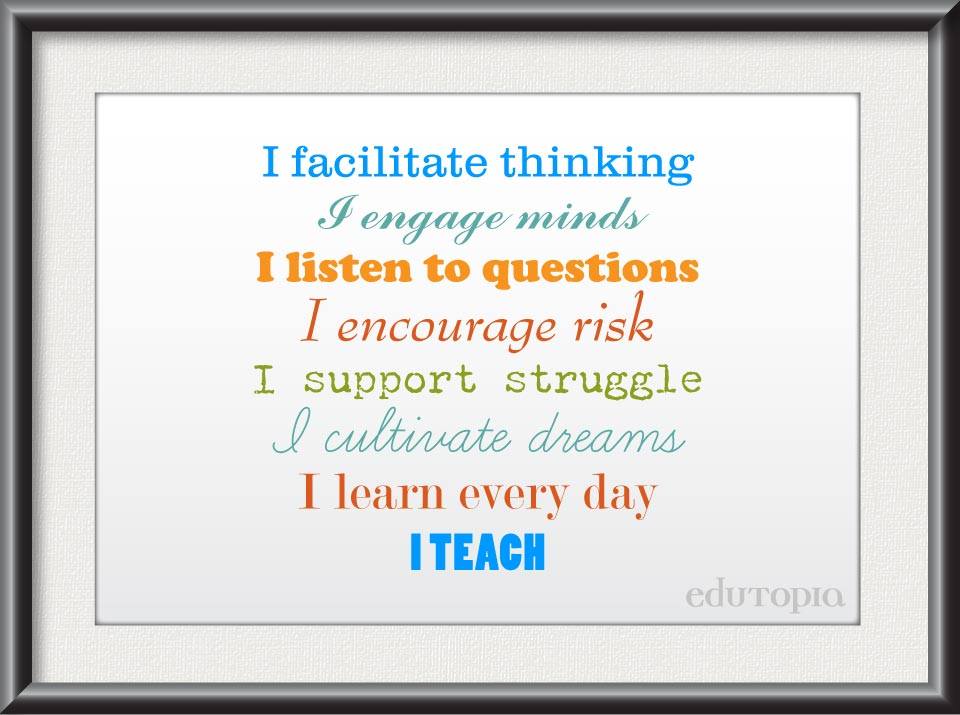
From Edutopica

Why Do You Teach?

Embedded image permalink

Contrary to the way we may all feel this week with all the testing, we need to reflect on how important teachers are to their students and to be reminded of the work we do as teachers. 

Tuesday, March 3, 2015

Rx for dealing with 6 common classroom distractions


The Google Journey

With all of the buzz around the district surrounding Google, many teachers are interested in learning more.  Fortunately, Google has provided many free, self-guided training resources for individuals to use.

If there is a specific tool that you would like to learn more about, you can visit the Google for Education training page.  Along the left sidebar you will find a list of Google tools.  Just click on the tool you would like to learn more about.  You will receive an overview of the tool, along with self-guided lessons to teach you about the features.  Many tools have basic as well as advanced lessons, so you can get as in-depth with your learning as you would like.  With most tools there is even a quick quiz at the end to help you gauge your understanding.  This page is enough to get many teachers started on a new tool of their choosing.


However, if you would like to learn more, you may want to pursue one of the Google training programs.  These programs can help you become a Certified Google Educator.  This blog post details the requirements of the program nicely.

No matter which path you choose, hopefully it will be a journey filled with tricks and tips that we can all use to become more effective and efficient.  Happy learning!